Ready to take legal action against lies that damaged your reputation? Learn how to file a defamation lawsuit from start to finish—including legal elements, court filing tips, and how to gather winning evidence.
Online Defamation Law and Removal Advice
Ready to take legal action against lies that damaged your reputation? Learn how to file a defamation lawsuit from start to finish—including legal elements, court filing tips, and how to gather winning evidence.

Wondering if you can sue someone for slander? Explore the legal standards, how to prove a slander claim, and what you can recover if false statements have harmed your reputation.
Slander in the workplace can damage careers, reputations, and trust. This guide explores how to recognize, address, and prevent workplace slander—equipping both employees and employers with the tools to navigate these complex issues effectively.

Spoken lies can damage your career, relationships, and well-being. This in-depth guide explains what slander is, how it differs from libel, how to prove a claim, and what legal actions and preventive measures you can take to safeguard your reputation.

Online libel can damage your reputation, career, and peace of mind. This guide offers practical legal strategies and online reputation tools to safeguard yourself from defamatory attacks and restore your good name.
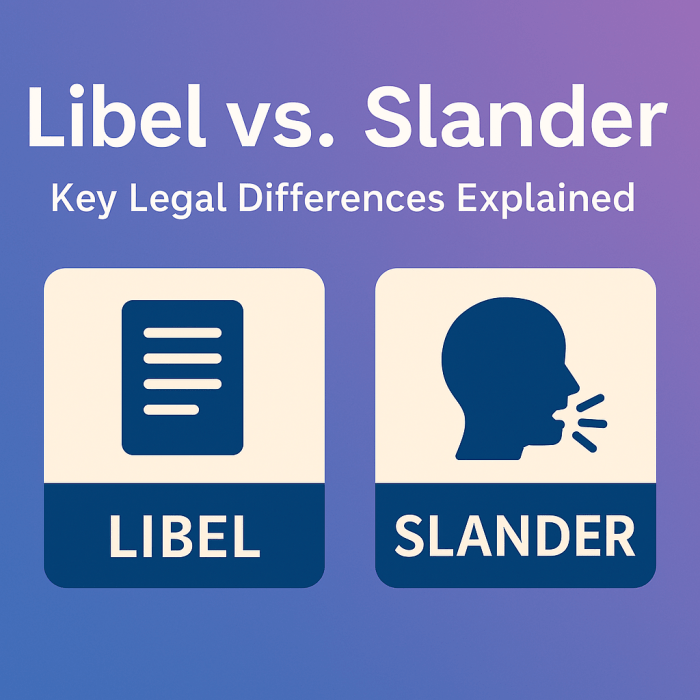
Not all defamation is created equal. While both libel and slander can destroy reputations, their definitions, legal thresholds, and remedies differ significantly. This guide explains the critical distinctions between these two types of defamation and what you should know if you’re affected.
False statements in writing can destroy reputations overnight. This guide explains the legal definition of libel, how it differs from slander, and what to do if you're a victim of written defamation.
Defamation isn't just legal jargon—it's a real-world threat. These 10 true defamation examples reveal the power of false statements and the legal battles that followed. Learn from the outcomes to better protect your reputation.

A rogue blogger who named two women accused of having affairs with Network Seven boss Tim Worner has been jailed for four months for contempt of court, after a judge found his conduct "borders on obsession".
In a judgment delivered on Thursday, Supreme Court Justice Ian Harrison said Shane Dowling "flagrantly" and "enthusiastically" breached non-publication orders in naming the women on his website.
Photo: YOUTUBE
Blogger Shane Dowling is serving a four-month prison sentence for contempt.
He was led from the court in handcuffs by three corrective services officers.
The women, given the pseudonyms Jane Doe 1 and 2, were named in court documents during the height of the legal battle between Mr. Worner and his former lover Amber Harrison.
Seven West Media chief executive Tim Worner. Photo: Ben Rushton
The women strenuously denied the allegations and their names were suppressed by the court ahead of their defamation proceedings.
Supreme Court Justice Ian Harrison found Dowling guilty on March 15 of contempt of court after he flouted court orders to remove the names of the women from his website and refrain from re-publishing the allegations. The court heard Dowling had published fresh stories naming the women as recently as July 15.
During the sentencing on Thursday, Justice Harrison told Dowling: "If you are currently publishing matters on your phone ... I'd ask you to stop."
"OK then," Dowling replied.
Justice Harrison said Dowling had "deliberately set out to disobey" the court's orders.
He said Dowling appeared to see himself as a "fierce proponent of free speech" and was "ferociously committed to the righteousness" of his views.
Justice Harrison said Dowling's "enthusiasm for the cause as he perceives it borders on obsession" but he was "nonetheless to my observation a man of some intelligence who doubtless appreciates the proper legal foundation for his contempt".
"It is regrettable that his written protestations elide self-righteous indignation with innocence," he said of Dowling's submissions to the court.
Justice Harrison said it was an "available inference" that Dowling sought "to benefit from the publication of the ... [women's] names by attracting public interest to his website and by soliciting financial support".
"It is a further available conclusion that he seeks to draw attention to his defiance of the court orders, as a way to gain sympathy and notoriety or simply public attention, which he apparently perceives as being a benefit to him, perhaps because he considers it will increase his public profile," he said.
In submissions to the court, Dowling said he believed he would be classified "correctly" as a "political prisoner" by social media users if he was jailed.
Dowling wrote that he had done "nothing more than any journalist does everyday [sic] around the country", as the women's names "were in legal documents".
But Justice Harrison said he had "done more" than journalists do on a daily basis and had disobeyed court orders to remove the offending articles.
A spokesman for Seven said the women "had been falsely accused by Amber Harrison of having relationships with Tim Worner".
"The blogger himself had no defense or evidence to support his defamatory articles and didn't check for accuracy and had no relevant defense as to why he breached the court's orders," the spokesman said.

The web’s hive mind has a long memory — and a mean streak — which can be a serious problem for anyone trying to move past an ugly divorce, a criminal record, a bankruptcy or a foolish mistake. For years, officials turned a blind eye to the problem, declaring the web a wild and unruly frontier.
But now, two decades after the advent of Google (the domain google.com was registered on Sept. 15, 1997), courts and regulators are increasingly asking the question: Should the internet’s cache of damaging personal data be made to disappear at some point? Or should it remain in place forever, burned onto the online presence of the once guilty like some kind of digital scarlet letter?
Those who argue for a best-before date call it “the right to be forgotten” and say it should be a fundamental tenet of the digital age.
But free speech advocates contend that enshrining the right in law will diminish the revolutionary power of the web by creating “black holes” where information can disappear.
“There are two competing interests at the heart of almost everything that goes on online,” says Montreal lawyer Allen Mendelsohn, an internet law specialist. “In the simplest terms: It’s your right to your reputation versus the other person’s right to freedom of expression.”
Europe and Argentina are among the jurisdictions that have already recognized an individual’s right to be forgotten.The issue has played out for years in Europe, where regulators are now wrestling with the thorny question of how to enforce removal orders on the transnational, shape-shifting web.
In May 2014, the European Union’s highest court ruled that Google must remove links to damaging personal information deemed inadequate, irrelevant or excessive.
The ruling — based on the complaint of a Spanish man who wanted Google to remove links to a 1998 news story about his bankruptcy —said search engines were data “controllers,” not just neutral conduits, and therefore had a responsibility to cleanse unfair and damaging information.
In its wake, Google received a deluge of requests for cache removals from EU residents: more than 735,000 people filled out the company’s digital application form.It has since delisted 1.1 million search results inside the EU, according to the company’s public transparency report.
France’s data protection agency, however, said that wasn’t good enough, and it has ordered Google to censor those same links worldwide so that someone conducting a search in Canada, for instance, couldn’t find information unavailable in the EU. (Google Search uses different domains for different countries: Canada is http://www.google.ca, Germany is http://www.google.de, Spain is http://www.google.es, Australia is http://www.google.com.au, the U.S. is http://www.google.com.)
The company says the case has profound implications for the free flow of digital information.Google has challenged the order to France’s Conseil d’Etat, which in July referred the issue to the EU’s top court.
“If French law applies globally, how long will it be until other countries – perhaps less open and democratic – start demanding that their laws regulating information likewise have global reach?”
Google general counsel Kent Walker wrote in a recent blog post.
Information that is legal in one country, he said, is verboten in another: “Thailand outlaws insults to its king; Brazil outlaws negative campaigning in political elections; Turkey outlaws speeches that denigrates Ataturk or the Turkish nation.”
He warned that the case, if upheld, could trigger “a global race to the bottom.”
Google is already in an uncomfortable situation. By recognizing the right to be forgotten, European courts have handed the multinational the judge-like responsibility of weighing individual privacy rights against the public’s right to know.
Google officials have reviewed more than two million EU web addresses (URLs), and have decided to remove 56.9 per cent of them.
The company provides examples of the decisions it faces, but it does not set out hard and fast rules for removals, nor does it explain how its officials balance public versus private interests.
The Global Commission on Internet Governance, an independent think-tank led by former Swedish prime minister Carl Bildt, decried that state of affairs in a 2016 report: “Private companies — as opposed to courts and legislatures — are only accountable to their shareholders; they should not be the arbitrator on how to weigh fundamental rights and public interests.”
Courts around the world are now wrestling with issues raised by privacy on the internet, and Canada is no exception.
In January, the Federal Court of Canada issued a judgment that excoriated Sebastian Radulescu, the owner of the website Globe24h.com, as someone who “has essentially made a business of exploiting the privacy of individuals for profit.”